
The Small Heating Components That Keep Modern Equipment Running
Everyone notices the robots in modern factories, but the real work often happens behind the scenes. Discover how cartridge heaters and precision industrial heating quietly power manufacturing, improve product quality, increase efficiency, and help build the reliable technologies behind countless everyday products.
Everyone loves talking about the robots.
Fair enough—they're cool.
Watch a robotic arm assemble a car door with near-perfect precision, and it's hard not to be impressed. Throw in a few AI-powered inspection cameras and an automated warehouse, and suddenly every factory starts looking like it's preparing for the next sci-fi movie.
But here's a hot take.
Robots aren't the reason modern factories work.
They're the reason modern factories look impressive.
The reason they actually work? That's usually hiding somewhere inside the machine, quietly doing its job without asking for attention.
Sometimes it's a sensor.
Sometimes it's a bearing.
Sometimes it's a tiny heating component no bigger than your hand.
Not exactly the kind of technology people brag about at parties.
But remove it from the equation, and that million-dollar production line suddenly has a very expensive problem.
That's one of our favorite things about engineering.
The technologies that make headlines are rarely carrying the entire load. More often than not, they're standing on the shoulders of dozens of quieter innovations that simply refuse to fail.
Industrial heating is one of those innovations.
It doesn't have flashy launch events.
Nobody waits in line to buy the newest industrial heater.
And yet, without precise heat, an incredible amount of modern manufacturing would either slow down dramatically—or stop altogether.
Kind of wild when you think about it.
We Have a Weird Relationship With Technology
Here's something worth noticing.
We naturally judge technology by what we can see.
Big machine?
Must be important.
Huge touchscreen?
Definitely advanced.
Robot with six moving arms?
Now we're talking.
But technology doesn't really work like that.
Think about your phone.
Most people get excited about the camera.
Or the display.
Maybe the processor if they're into specs.
Meanwhile, there are dozens of tiny components inside that phone quietly making sure everything actually works.
You probably couldn't name most of them.
That doesn't make them less important.
Factories operate on the exact same principle.
The biggest machine on the production floor often depends on hundreds of smaller components working together with incredible consistency.
It's less like a superhero movie and more like an orchestra.
Everyone notices the conductor.
The performance still falls apart if half the musicians stop playing.
That's why experienced engineers don't automatically ask,
"What's the biggest machine here?"
They ask,
"What's the weakest link?"
Because that's usually where reliability is won—or lost.
Here's the Part Most People Miss About Manufacturing
Ask someone how factories make products and you'll probably hear words like:
Automation.
Robotics.
Artificial intelligence.
Lasers.
Computers.
None of those answers are wrong.
They're just incomplete.
Manufacturing is really about one thing:
Controlling variables.
Temperature.
Pressure.
Speed.
Timing.
Material flow.
Humidity.
Force.
Engineers spend an incredible amount of time making sure every one of those variables behaves exactly the way it's supposed to.
Because materials are surprisingly picky.
Plastic doesn't always melt the same way.
Metal doesn't always expand the same way.
Adhesives don't always cure at the same speed.
Even something as simple as room temperature can influence how certain manufacturing processes perform.
Honestly?
Materials can be a little dramatic.
Treat them perfectly, and they'll give you beautiful, repeatable results.
Change one condition just enough, and suddenly they're behaving like completely different substances.
That's why manufacturing isn't simply about making things.
It's about making the same thing thousands—or even millions—of times with almost identical results.
That's a much harder problem to solve.
Heat Is Doing Way More Work Than You Think
Let's play a quick game.
Look around the room you're in.
Your laptop.
Your keyboard.
The plastic casing on your monitor.
The coffee maker in the kitchen.
The packaging from your last online order.
The electrical outlets in the wall.
Odds are, nearly everything you just looked at depended on carefully controlled heat at some point during manufacturing.
Not because factories like making things hot.
Because heat changes materials.
It softens.
It cures.
It bonds.
It shapes.
It seals.
It hardens.
It allows raw materials to become finished products.
That's a pretty important job.
Yet heating technology rarely gets mentioned when people talk about manufacturing innovation.
Maybe because it's been around for so long.
Or maybe because it's doing its job so well that nobody notices.
Either way, it deserves more credit.
Turns Out, "Hot" and "Precisely Hot" Are Completely Different Things
Here's where manufacturing gets surprisingly interesting.
Outside a factory, we usually think of heat in simple terms.
Hot.
Cold.
Warm enough.
Too hot.
Inside a factory?
Those descriptions are almost meaningless.
Imagine baking cookies.
If your oven randomly jumps from 325°F to 425°F every few minutes, you're probably not getting a very consistent batch.
Some cookies burn.
Others stay undercooked.
Now imagine making ten thousand cookies that all need to taste exactly the same.
That's much closer to the challenge manufacturers face every day.
Except instead of cookies, they're producing medical devices.
Automotive parts.
Electronics.
Packaging.
Industrial equipment.
Consumer products.
Suddenly, a few degrees isn't "close enough."
It's the difference between passing quality inspection and throwing an entire production run into the scrap bin.
This is why engineers care so much about temperature control.
They're not trying to make things hotter.
They're trying to make heat predictable.
There's a big difference.
Meet One of Manufacturing's Quiet MVPs
This is where cartridge heaters enter the story.
If you've never heard the term before, don't worry.
Most people haven't.
They're one of those technologies that spend their entire careers working behind the scenes.
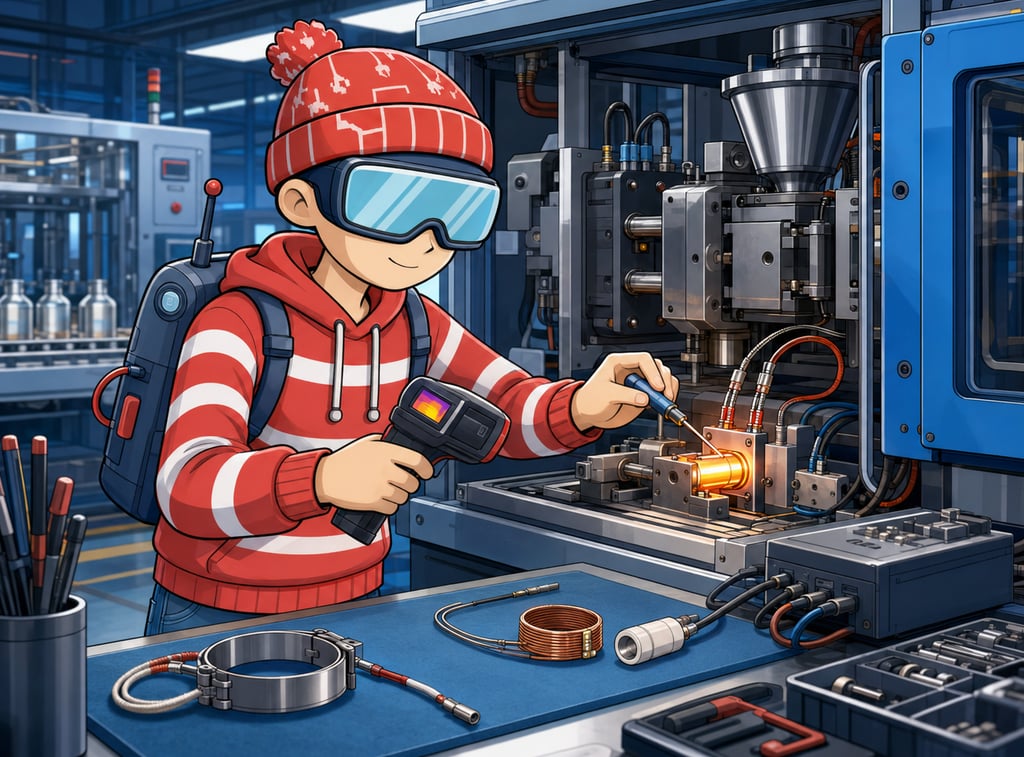
A cartridge heater is a compact cylindrical heating element designed to fit inside precisely machined holes in industrial equipment.
That explanation is technically correct.
It's also a little boring.
Let's make it easier.
Imagine trying to warm up a thick metal block.
You could point a heat gun at the outside and wait for the warmth to slowly spread inward.
Eventually, it would get there.
Or...
You could place the heat source inside the metal itself.
Now the heat starts exactly where it's needed.
That's essentially what cartridge heaters do.
Instead of heating a large area and hoping everything evens out, they deliver concentrated, controlled heat directly into the equipment that's doing the work.
It's a simple idea.
Which is usually a sign of good engineering.
The best solutions often look obvious after someone else invents them.
Manufacturers rely on cartridge heaters because that direct approach makes it easier to maintain accurate temperatures in molds, dies, sealing equipment, packaging systems, food processing machinery, medical devices, laboratory equipment, and countless other industrial applications where consistency matters more than raw heat.
It's not trying to be flashy.
It's trying to be reliable.
That's a much harder goal than people realize.
Why Engineers Obsess Over Consistency
Here's a question.
Would you rather buy a product that's amazing 90% of the time...
...or one that's consistently excellent every single time?
Easy choice.
Customers don't just purchase products.
They purchase expectations.
If someone buys a medical device, they expect it to perform exactly as intended.
If someone buys an automotive component, they expect it to fit perfectly.
If someone buys a sealed food product, they expect the packaging to protect what's inside.
None of those expectations happen by accident.
They're the result of manufacturing systems repeating the same process again.
And again.
And again.
Sometimes millions of times.
Consistency isn't glamorous.
But it's probably the single most valuable thing a factory can produce.
Because once consistency disappears, quality usually follows it out the door.
That's why small technologies like precision heating deserve more attention than they usually get.
They don't just help make products.
They help make every product behave like the one before it.
And honestly?
That's a much bigger engineering challenge than it sounds.
Tiny Problems Have an Annoying Habit of Becoming Expensive
Here's something that doesn't get enough attention outside the manufacturing world.
Factories rarely shut down because of one dramatic, movie-worthy failure.
Most of the time, problems start small.
A sensor begins drifting ever so slightly out of calibration.
A bearing develops just a little more friction than it should.
A connection loosens after thousands of production cycles.
Or a heating component stops delivering temperature as consistently as it did six months ago.
None of those issues sounds catastrophic.
That's exactly why they're dangerous.
Small problems are easy to ignore because the production line usually keeps moving.
Until one day it doesn't.
This is where experienced engineers think differently.
They're not waiting for something to fail.
They're watching for tiny changes in performance long before failure becomes obvious.
It's a mindset that's surprisingly similar to preventive healthcare.
Getting a yearly check-up isn't exciting.
Neither is replacing a worn component before it breaks.
But both are usually much cheaper than dealing with the alternative.
Why "Close Enough" Usually Isn't Good Enough
Let's say you're building a backyard deck.
Being off by a millimeter probably isn't going to ruin your weekend.
Now imagine manufacturing parts for a medical device.
Or an aircraft.
Or an electric vehicle.
Suddenly, "close enough" isn't exactly a comforting phrase.
Modern manufacturing depends on repeatability.
Not because engineers are perfectionists.
Because customers expect Product #50,000 to perform exactly like Product #1.
That expectation is surprisingly difficult to meet.
Materials don't behave exactly the same every day.
Humidity changes.
Production speeds change.
Equipment ages.
Even the surrounding environment can influence manufacturing conditions.
Reliable thermal control helps remove one major variable from that equation.
The fewer surprises engineers have to manage, the more consistent the finished products become.
It's not about chasing perfection.
It's about eliminating unnecessary uncertainty.
The Hidden Cost of Inconsistent Heat
Here's where things get expensive.
Imagine producing thousands of plastic components every day.
The temperature drifts just enough that two percent of the parts don't meet quality standards.
Two percent doesn't sound terrible.
Until you remember you're producing hundreds of thousands of parts every month.
Now you're talking about wasted materials.
Additional inspections.
Extra labor.
Production delays.
Customer complaints.
More energy spent remanufacturing parts that should have been correct the first time.
It's amazing how quickly tiny inefficiencies become very large invoices.
This is why manufacturers don't just think about heat.
They think about stable heat.
One creates temperature.
The other creates confidence.
Heat Doesn't Work Alone
One thing we really appreciate about manufacturing is how collaborative it is.
Not between people—between technologies.
A heating system doesn't operate in isolation.
It works alongside sensors measuring temperature in real time.
Controllers constantly adjust power levels.
Software tracks performance.
Automation coordinates timing with the rest of the production line.
Operators monitor trends instead of reacting to emergencies.
It's a team effort.
Take away one piece of that system, and everything else has to work harder.
That's one reason manufacturing has become so much more sophisticated over the past couple of decades.
Factories aren't just buying better machines.
They're building smarter ecosystems.
Every component contributes.
Some just happen to be quieter than others.
Bigger Machines Don't Automatically Mean Better Engineering
This feels slightly counterintuitive.
People naturally assume the biggest machine must also be the most impressive piece of engineering.
Not always.
Sometimes the smartest engineering decision is making a smaller component dramatically more reliable.
Think about commercial airplanes.
Passengers notice the engines.
Engineers spend an incredible amount of time thinking about thousands of components passengers never see.
Because that's where reliability lives.
Manufacturing follows the same philosophy.
An expensive molding machine is impressive.
The thermal system that helps it produce identical parts all day?
That's impressive too.
It just doesn't get nearly as much attention.
Honestly, engineering has always had a bit of an image problem.
The most important work often happens in places nobody thinks to look.
Smart Factories Need Smart Fundamentals
You've probably heard the phrase Industry 4.0.
It's become one of those buzzwords that gets attached to almost everything.
But underneath the marketing, there's actually a useful idea.
Factories are becoming better at understanding themselves.
Machines collect data.
Sensors monitor performance.
Software identifies patterns.
Operators receive alerts before small issues grow into major ones.
Artificial intelligence helps analyze information faster than humans can.
That's genuinely exciting.
But here's the part that sometimes gets overlooked.
None of that replaces good engineering.
Artificial intelligence can't magically fix inconsistent hardware.
A predictive maintenance system can't maintain temperature if the underlying equipment isn't performing properly.
Digital technology makes better decisions.
Reliable hardware gives those decisions something worth acting on.
One doesn't replace the other.
They strengthen each other.
That's a much healthier way to think about the future of manufacturing.
Predictive Maintenance Is Basically Common Sense With Better Data
Let's use an analogy.
Imagine your car could tell you,
"Hey, my brakes still work... but they're wearing down faster than normal. You should probably schedule maintenance next week instead of waiting until something goes wrong."
You'd probably appreciate that.
Factories increasingly work the same way.
Sensors continuously monitor operating conditions.
If temperatures begin drifting.
If heating cycles take longer.
If energy usage starts increasing.
If performance slowly changes over time.
The system notices.
Maintenance teams can investigate before customers ever see a defective product.
It's less about preventing disasters.
It's more about preventing inconveniences from becoming disasters.
That's a surprisingly smart use of technology.
Why Efficiency Is About More Than Saving Electricity
Whenever people hear the word efficiency, they usually picture lower utility bills.
That's part of it.
But manufacturing looks at efficiency a little differently.
Efficient production also means:
Less wasted material.
Faster production cycles.
More consistent quality.
Reduced equipment wear.
Fewer unexpected shutdowns.
Better use of labor.
Higher overall productivity.
Notice something?
Only one of those benefits directly mentions energy.
Everything else affects the entire business.
That's why manufacturers invest so heavily in improving processes that already seem to work.
They're not chasing perfection.
They're chasing incremental gains.
Shaving three seconds off a production cycle doesn't sound revolutionary.
Until you repeat that cycle hundreds of thousands of times every year.
Suddenly those three seconds become hundreds of hours.
Engineering loves compound improvements.
Small wins repeated consistently almost always beat one dramatic breakthrough.
The Best Engineering Usually Goes Unnoticed
Here's a thought.
When was the last time you complimented your Wi-Fi router?
Probably never.
You only think about it when it stops working.
The same thing happens with industrial technology.
Nobody walks through a factory saying,
"Wow... those heating components are absolutely crushing it today."
They shouldn't have to.
The highest compliment an engineer can receive is often complete invisibility.
If equipment quietly performs its job day after day without creating problems, it becomes part of the background.
That's success.
It's also strangely satisfying.
Because while the rest of the world gets excited about whatever new technology is trending this week, factories continue relying on something much less glamorous:
Reliable systems.
And honestly?
Reliable never goes out of style.
So... Where Does Industrial Heating Go From Here?
Here's the funny thing about manufacturing.
The future usually arrives in headlines.
The real progress happens in the background.
You'll see articles about AI transforming factories.
Videos of robots working without human intervention.
Predictions that automation will completely reinvent production.
Some of those predictions are probably right.
But here's our take.
The next generation of manufacturing won't succeed because factories suddenly become futuristic.
It'll succeed because thousands of existing technologies quietly become better.
Heating systems will become more energy efficient.
Sensors will become more accurate.
Control systems will respond faster.
Predictive maintenance will become even smarter.
Materials will continue improving.
None of those upgrades is likely to dominate your social media feed.
Collectively?
They're a very big deal.
Because manufacturing has never really been about chasing the newest gadget.
It's about reducing uncertainty one improvement at a time.
Sustainability Isn't Always Loud
When people think about sustainability, they usually picture giant solar farms, electric trucks, or massive wind turbines spinning on the horizon.
Those projects matter.
A lot.
But manufacturing has taught us something interesting.
Sometimes sustainability looks... surprisingly boring.
It's reducing waste by one percent.
It's shortening a production cycle by five seconds.
It's improving heat transfer just enough that equipment uses less energy every day for the next ten years.
None of those changes will trend on social media.
Together, though, they can make an enormous difference.
Think about a production line running twenty-four hours a day.
Now imagine every cycle becomes just a little more efficient.
A little less energy.
A little less waste.
A little less downtime.
Those "little" improvements quickly become millions of dollars saved over the lifetime of a facility.
Engineering has always been really good at this.
It doesn't always chase dramatic breakthroughs.
Sometimes it quietly stacks small wins until the results become impossible to ignore.
Why We Should Probably Stop Calling This "Boring Tech"
Let's be honest.
Industrial heating has an image problem.
Say the words artificial intelligence, and people lean in.
Say thermal management, and the conversation suddenly gets a lot quieter.
We get it.
One sounds futuristic.
The other sounds like something hidden inside an engineering textbook.
But here's the irony.
One of those technologies is responsible for helping manufacture everything from smartphones and medical devices to automotive parts and consumer electronics.
The other gets all the headlines.
This isn't an argument against AI.
AI is genuinely exciting.
It's simply a reminder that technology isn't a popularity contest.
The technologies getting the least attention are often doing the most work.
And honestly?
That's kind of refreshing.
Not every innovation needs flashy branding.
Some innovations just need to work.
The Bigger Story Isn't Really About Heaters
If you've made it this far, you've probably noticed something.
This article stopped being about heating components a while ago.
They're really just an example.
The bigger story is about how progress actually happens.
We love breakthrough moments.
The first smartphone.
The first reusable rocket.
The latest AI model.
Those moments are exciting because they're easy to see.
What's harder to see are the thousands of incremental improvements happening behind the scenes every single year.
Better manufacturing processes.
Stronger materials.
More reliable electronics.
Smarter sensors.
Improved thermal control.
None of those changes feels revolutionary by itself.
Together, they completely reshape industries.
That's why engineering is such an interesting field.
It rarely depends on one giant leap.
More often, it depends on thousands of people making something just a little bit better than it was yesterday.
That's not a dramatic story.
It's probably a more accurate one.
The TechNaldo Take 🚀
Here's our hot take.
We spend way too much time asking,
"What's the next big thing?"
Maybe we should spend more time asking,
"What's quietly making today's technology possible?"
Because that's where some of the coolest engineering lives.
Behind every impressive robot is a system of components keeping it running.
Behind every automated production line is an ecosystem of technologies working together.
Behind every perfectly manufactured product is a process that's been refined, tested, adjusted, and improved countless times.
Industrial heating is one piece of that puzzle.
Not the loudest piece.
Not the most glamorous one.
But definitely one of the most important.
It's a good reminder that reliability isn't boring.
It's underrated.
There's a difference.
Final Thoughts
Technology has a habit of rewarding visibility.
The products with the biggest announcements usually receive the most attention.
The systems quietly supporting them often don't.
Manufacturing flips that idea upside down.
Inside a factory, nobody really cares which component gets the spotlight.
They care which components keep showing up every day and doing exactly what they're supposed to do.
That's why precision heating matters.
Not because it's flashy.
Not because it generates headlines.
Because it helps create the consistency modern manufacturing depends on.
From medical devices and electronics to food packaging and industrial equipment, reliable thermal control plays a role in products most of us use without ever thinking about how they were made.
And maybe that's the biggest takeaway.
The future of technology probably won't be built by one revolutionary invention.
It'll be built the same way progress has always happened.
Through thousands of smart engineering decisions, countless refinements, and the quiet technologies that make everything else possible.
So the next time someone talks about the future of manufacturing, go ahead and appreciate the robots.
They're impressive.
Just don't forget the tiny components hidden inside the machines.
Because sometimes the technology that changes the world isn't the one getting all the attention.
It's the one quietly making sure everything else works.
And honestly?
That might be the coolest technology of all.
Subscribe to my newsletter