
The Rise of AI Side Hustles
AI side hustles are everywhere — but which ones actually work? In this TechNaldo deep dive, we break down why AI side hustles exploded, what people really mean by “making money with AI,” why most attempts fail, and how sustainable opportunities are actually built. A grounded, realistic look at AI as leverage — not a shortcut.
At some point, AI side hustles went from interesting to exhausting.
Every scroll brings a new promise.
“Make money with AI.”
“Automate your income.”
“Let bots do the work while you sleep.”
It sounds exciting. It also sounds vague in a way that should raise an eyebrow.
The truth is less dramatic — and more useful.
AI has created real opportunities. People are genuinely using it to work faster, offer new services, and lower the barrier to starting small projects. That part is real.
What AI hasn’t done is remove effort.
It hasn’t removed judgment.
And it definitely hasn’t turned side hustles into magic.
The AI side hustles that last don’t look flashy. They look like work — just with better tools.
Why AI Side Hustles Exploded So Fast
AI side hustles didn’t come out of nowhere. They hit at the perfect intersection of timing, access, and attention.
A few things happened at once.
AI tools became usable by non-technical people.
Results appeared instantly instead of weeks later.
And social platforms rewarded people for sharing “how I did this” stories.
That combination is powerful.
When tools feel accessible and outcomes feel fast, people experiment. When experimentation is visible, it spreads.
That’s how side hustles are born.
Low Barriers Change Behavior
In the past, starting a side hustle usually required:
learning a skill deeply
buying software
building something from scratch
AI lowered those barriers.
Now you can:
draft content in minutes
generate visuals quickly
summarize research instantly
automate repetitive steps
That doesn’t guarantee success — but it does encourage trying.
And when more people try, more people talk about it.
The Feedback Loop of Visibility
AI side hustles didn’t just spread because they worked. They spread because they were visible.
People posted:
screenshots
dashboards
before-and-after examples
income graphs
Social platforms amplify outcomes, not process.
You see the result, not the dozens of attempts that didn’t work. That creates a distorted picture of how easy things really are.
That distortion matters.
What People Mean When They Say “AI Side Hustle”
This term gets used loosely, so it’s worth clarifying.
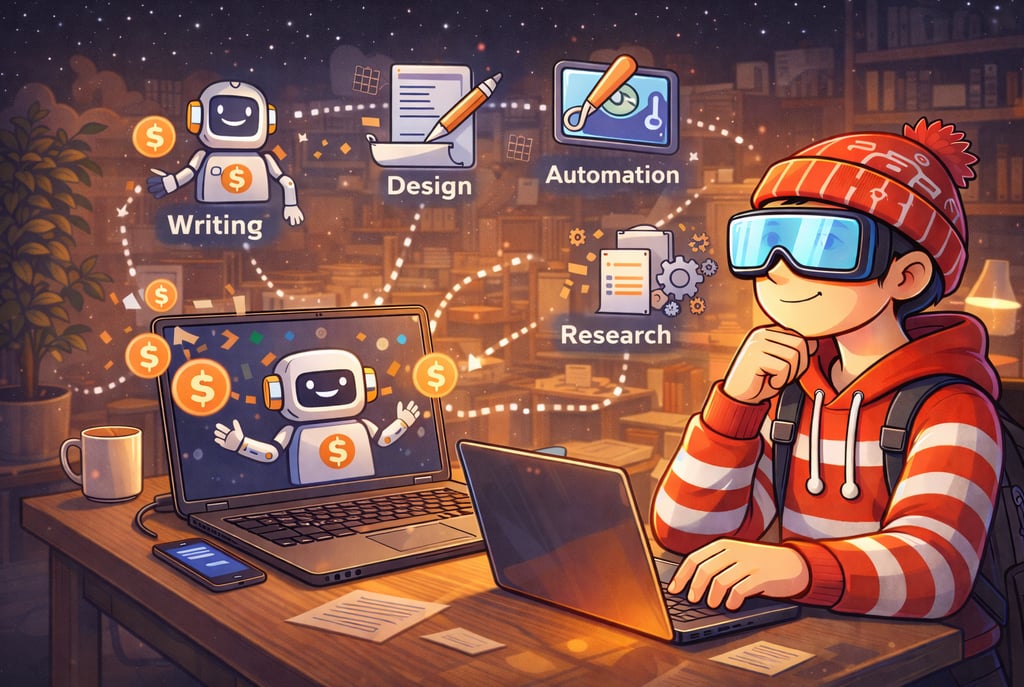
Most “AI side hustles” aren’t about AI doing work for you. They’re about AI helping you do work faster.
That’s a big difference.
In practice, AI side hustles usually fall into one of these categories:
services enhanced by AI
workflows automated with AI
products created faster with AI
Very few are fully autonomous. And the ones that claim to be usually break first.
AI Is the Tool, Not the Hustle
This is where a lot of people get stuck.
They focus on the tool instead of the value.
AI doesn’t create income on its own. It amplifies whatever you already bring:
writing ability
design sense
research skills
organizational thinking
If there’s nothing underneath, AI just produces noise faster.
That’s why tool-first side hustles tend to collapse quickly.
The AI Side Hustles That Actually Work
Let’s talk about what’s working — not in theory, but in practice.
Not promises. Patterns.
Writing and Editing Support
This is one of the most common and most misunderstood areas.
AI hasn’t replaced writers. It’s changed how writing gets done.
People are using AI to:
draft faster
outline more clearly
edit more efficiently
adapt content for different formats
The side hustle isn’t “AI writing.”
It’s writing with AI support.
Clients still pay for:
clarity
tone
judgment
audience awareness
AI helps with speed. Humans still provide direction.
Design Assistance, Not Design Replacement
AI image tools didn’t eliminate designers.
They changed early-stage work.
People now use AI for:
concept exploration
mood boards
quick iterations
placeholders
Design side hustles that work use AI as a starting point, not a finished product.
Taste still matters. So does refinement.
Automation for Freelancers and Small Businesses
This is quieter, but more sustainable.
People are building small systems:
automating email responses
organizing client data
summarizing meetings
cleaning up workflows
These aren’t flashy. They’re valuable.
Businesses don’t care how impressive your tool is. They care that it saves time.
That’s leverage.
Research and Summarization Services
AI is excellent at handling volume.
People are using it to:
summarize long documents
organize research
extract key insights
prep briefs
The value isn’t the summary itself. It’s knowing what matters.
Clients pay for clarity, not raw output.
Templates, Micro-Tools, and Small Products
Some people are packaging AI-assisted workflows into simple products:
templates
prompt packs
checklists
lightweight tools
These work when they solve a specific problem for a specific audience.
They fail when they’re generic.
Why Most AI Side Hustles Fail
Now the uncomfortable part.
Most AI side hustles don’t last.
Not because AI stopped working — but because expectations were wrong.
Overcrowding Happens Fast
Low barriers invite competition.
When anyone can try something quickly, many people will. That compresses margins fast.
What worked as a side hustle for the first 1% becomes noise for the next 99%.
Timing matters more than people admit.
Tool-First Thinking Kills Differentiation
Many failed side hustles sound like this:
“I found a cool AI tool. How do I make money with it?”
That’s backwards.
Sustainable hustles start with:
“I see a problem. Can AI help solve it?”
Tools change. Problems persist.
Underestimating Human Judgment
AI can generate. It can’t decide what’s appropriate.
Side hustles fail when people:
skip quality control
overtrust outputs
remove themselves from the loop
Clients notice when no one is steering.
Platforms Aren’t Businesses
Many AI side hustles depend entirely on platforms:
marketplaces
social algorithms
ad networks
When the platform changes, the hustle disappears.
Ownership matters.
Skill Stacks Beat Tools Every Time
The most stable AI side hustles are built on skill stacks.
A skill stack is a combination of:
a core skill
contextual knowledge
AI as leverage
For example:
writing + niche knowledge + AI drafting
design sense + client needs + AI iteration
operations thinking + automation + AI summarization
AI increases output. It doesn’t replace expertise.
Why “Easy Money” Was Always a Red Flag
Whenever something is framed as effortless, it usually means effort is being hidden.
Either:
the work happened earlier
the risk is being ignored
the system won’t scale
Real side hustles look boring:
client communication
revisions
maintenance
problem-solving
AI doesn’t remove that. It just speeds parts of it up.
How to Spot a Sustainable AI Side Hustle
Instead of chasing trends, look for signals.
A sustainable AI side hustle usually has:
real clients, not just views
repeat usage, not one-off wins
clear value, not vague potential
boring consistency
If something only works when it’s new, it’s probably not durable.
What AI Won’t Replace
This part gets lost in hype.
AI struggles with:
taste
trust
responsibility
context
Clients don’t pay just for output. They pay for someone to be accountable.
That’s not changing anytime soon.
A Healthier Way to Think About AI Income
Instead of asking:
“How do I make money with AI?”
Try asking:
“What work do I already do — and where does AI reduce friction?”
That mindset leads to:
better integration
realistic expectations
sustainable growth
AI works best as an amplifier, not a shortcut.
The Long Game Looks Boring (In a Good Way)
The people still earning from AI side hustles a year from now will look unremarkable.
They’ll:
respond to emails
adjust workflows
refine offers
maintain systems
No viral moments. No screenshots. Just quiet leverage.
That’s usually how real income works.
One Last Thought
AI didn’t create side hustles.
It exposed how many people were already looking for flexibility, leverage, and control over their work.
AI makes some paths faster. It doesn’t make them effortless.
If you treat it like a tool — not a promise — it can be powerful.
If you treat it like a shortcut, it will disappoint you quickly.
That distinction is the difference between hype and something that lasts.
Subscribe to my newsletter