
The Invisible Technology That Keeps Modern Travel Running
From online booking and secure payments to cloud platforms and cybersecurity, modern travel depends on invisible technology working behind the scenes. Learn why proactive IT management, reliable infrastructure, and trusted technology partnerships help travel businesses deliver seamless experiences customers expect every time.
You know what's kind of funny?
People spend months planning a trip they'll remember for years...
...and almost none of them think about the technology that makes it possible.
They'll compare airfare across five different websites.
Book a hotel with two taps.
Get a confirmation email before they've even closed the browser.
Download a boarding pass.
Reserve an airport shuttle.
Add the itinerary to their calendar.
Share the trip with friends.
Maybe even unlock a hotel room using nothing more than a phone.
It all feels effortless.
Almost expected.
Until something breaks.
The flight reservation disappears.
The payment gets processed twice.
The hotel can't find the booking.
The travel agency loses access to its reservation system.
Suddenly, technology becomes the most important part of the trip.
That's the thing about really good technology.
You rarely notice it when it's working.
You notice the second it isn't.
And honestly?
That might be the highest compliment any technology can receive.
Travel Isn't Just an Industry Anymore. It's a Giant Network.
Here's a question.
When you picture the travel industry, what comes to mind?
Airplanes?
Hotels?
Cruise ships?
Tour guides?
Probably.
But here's the weird part.
Those aren't really the systems keeping modern travel moving.
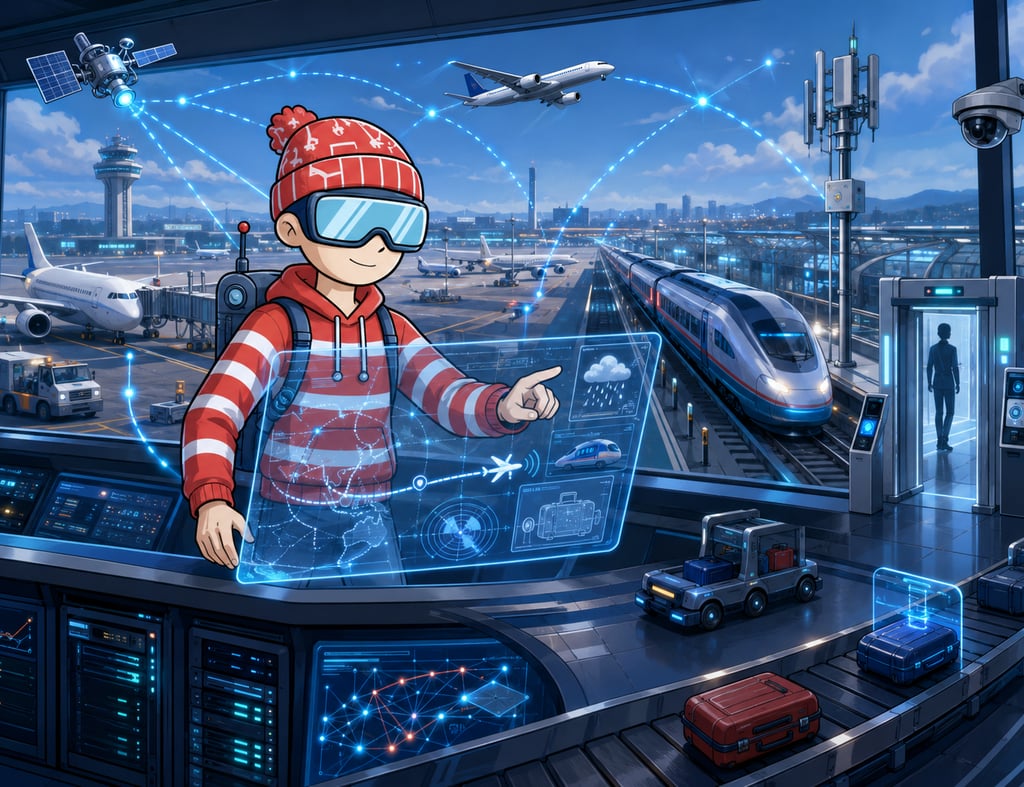
Behind every vacation is an invisible network of booking engines, payment processors, reservation databases, cloud platforms, cybersecurity tools, messaging systems, airline scheduling software, hotel management platforms, GPS services, identity verification systems, and thousands of servers quietly talking to one another every second.
It's less like one company running your trip.
It's more like an orchestra where hundreds of musicians somehow manage to stay in sync without you noticing.
Think about how many businesses touch a single vacation.
An airline.
A hotel.
A rental car company.
A travel advisor.
An insurance provider.
A payment processor.
A mapping service.
Maybe even a local tour operator.
Each one has its own software.
Its own databases.
Its own security requirements.
Its own employees.
Yet somehow your reservation usually flows between them without requiring you to think about any of it.
Honestly?
That's kind of incredible.
Because getting computers inside one company to communicate reliably is already difficult.
Getting entirely different businesses to exchange information securely and almost instantly?
That's an engineering achievement we probably don't appreciate enough.
We've Accidentally Raised the Bar
Here's something most of us never stop to think about.
Technology has quietly spoiled us.
Twenty years ago, booking travel looked very different.
You might call an agency.
Wait for someone to check availability.
Receive printed tickets.
Carry paper confirmations.
Hope you packed everything.
Today?
If a booking page takes longer than five seconds to load, we're already wondering if the website crashed.
If the confirmation email hasn't arrived within a minute, we refresh our inbox.
If a mobile app logs us out unexpectedly, we immediately assume something's wrong.
We've become incredibly impatient.
Not because we're unreasonable.
Because technology has taught us that things can happen almost instantly.
Once convenience becomes normal, it stops feeling like a luxury.
It becomes the expectation.
That's great news for travelers.
It's also a lot of pressure for the businesses making those experiences possible.
Every "Book Now" Button Starts a Chain Reaction
Let's follow what actually happens when you book a trip.
Not the version we imagine.
The real one.
You click Book Now.
Within seconds, software starts talking to other software.
The booking platform checks inventory.
A payment gateway confirms your card.
Fraud detection systems quietly look for suspicious activity.
Reservation databases update availability.
A confirmation email is generated.
A CRM records your booking history.
Your loyalty account receives points.
The airline adjusts its passenger count.
The hotel receives arrival information.
Someone's calendar syncs automatically.
And all of that can happen before you've finished reading the confirmation screen.
It's easy to think,
"Well... computers are supposed to do that."
Sure.
But here's the catch.
Most of those systems weren't built by the same company.
They're constantly exchanging information through APIs, cloud services, and secure integrations.
It's a little like organizing a group project where everyone speaks a different language.
The fact that it usually works is honestly more impressive than we give it credit for.
Technology Has Become Part of the Customer Experience
There was a time when technology supported travel.
Now, for many businesses, technology is the travel experience.
Long before anyone checks into a hotel or boards a plane, they've already interacted with technology dozens of times.
They've searched destinations.
Compared prices.
Read reviews.
Received recommendations.
Booked reservations.
Paid online.
Downloaded apps.
Opened confirmation emails.
Added flights to digital wallets.
Asked AI assistants whether they packed enough clothes for the weather.
That's all before the trip even begins.
The first impression of many travel companies isn't a smiling employee.
It's a website.
Or an app.
Or a booking platform.
That's a huge shift.
Because it means technology isn't sitting quietly in the background anymore.
It's often the very first employee a customer meets.
And unlike human employees...
Technology doesn't get tired.
It doesn't have bad days.
But it also doesn't get much forgiveness when something goes wrong.
Here's Where Things Get Complicated
Travel doesn't really have an "off" button.
Someone, somewhere, is booking a trip right now.
Someone else is checking into a hotel.
A delayed flight is being rebooked.
A cruise passenger is changing cabins.
A travel advisor is updating an itinerary.
An airline is adjusting schedules because of weather.
Business travelers are modifying reservations before tomorrow's meeting.
Families are booking vacations months in advance.
It's happening around the clock.
Which creates a unique challenge.
Many businesses can afford planned downtime.
A local office might schedule maintenance overnight.
A retail store can close after business hours.
Travel?
Someone is always traveling.
There isn't a magical window where technology can quietly disappear for maintenance without affecting anyone.
That raises the stakes considerably.
Because every minute systems aren't available can affect customers across different cities, countries, and time zones.
That's not just inconvenient.
That's expensive.
Downtime Doesn't Stay in the Server Room
One of the biggest misconceptions about IT is that technical problems stay technical.
They don't.
A reservation platform crashes.
Now customer support can't access bookings.
Payment systems slow down.
Now travelers start abandoning purchases.
Email services stop working.
Now customers aren't receiving confirmations.
A cybersecurity incident locks important files.
Now employees can't help the people standing in front of them.
Notice what happened?
An IT problem became a customer experience problem.
Then it became a business problem.
Technology has become so connected to everyday operations that separating "IT" from "the business" doesn't really make sense anymore.
They're the same conversation.
Especially in travel.
Because travelers don't care why something failed.
They care that it did.
The Best Technology Is Almost Invisible
Here's a challenge.
Think about the last flawless travel experience you had.
Now try remembering the technology behind it.
It's surprisingly difficult.
You probably remember the destination.
The people.
The food.
Maybe the hotel.
Not the reservation software.
Not the cloud infrastructure.
Not the cybersecurity systems protecting your payment.
Not the servers processing your confirmation email.
And that's exactly the point.
The goal of great technology isn't to demand attention.
It's to quietly remove friction so people can focus on what actually matters.
Kind of like a movie soundtrack.
You rarely notice it while watching the film.
Take it away, though...
...and suddenly everything feels strangely incomplete.
The best travel technology works the same way.
It fades into the background.
Not because it isn't important.
Because it's doing its job so well that you never have to think about it.
Waiting Until Something Breaks Is a Terrible Strategy
For years, businesses treated technology a little like an old family car.
As long as it still started every morning...
Why worry?
Eventually something would break.
Someone would call IT.
The problem would get fixed.
Life would move on.
That approach doesn't work anymore.
Modern travel businesses depend on dozens—sometimes hundreds—of connected systems.
Cloud platforms.
Communication tools.
Reservation software.
Customer databases.
Payment processing.
Security monitoring.
Remote collaboration.
Mobile devices.
One weak link can affect everything else connected to it.
That's why proactive technology has quietly become one of the smartest investments a business can make.
Instead of asking,
"How quickly can we fix problems?"
Leading organizations are asking,
"How do we prevent most of them from happening in the first place?"
That mindset changes everything.
Because the best technology support isn't measured by how many emergencies it handles.
It's measured by how many emergencies never happen.
And that's where the conversation starts getting really interesting.
Here's Why "Managed Services" Sounds Way Less Interesting Than It Actually Is
Let's be honest.
Managed services isn't exactly a phrase that gets people excited.
It sounds like something you'd skim past on a business website while looking for the pricing page.
But that's mostly a branding problem.
Because the idea itself is surprisingly simple.
Imagine owning a restaurant.
You could wait until the refrigerator stops working before calling someone.
Or you could have a professional regularly inspect it, monitor its performance, replace worn parts before they fail, and make sure it never surprises you during your busiest weekend.
Most restaurant owners wouldn't even hesitate.
Food spoils.
Customers leave.
Revenue disappears.
Technology works almost exactly the same way.
Waiting until systems fail might look cheaper on paper.
In reality, it's usually the most expensive option.
Managed services flip that mindset.
Instead of reacting to problems, they're built around preventing them.
That sounds less exciting than "emergency support."
It also happens to be much smarter.
Technology Doesn't Need to Be Perfect. It Needs to Be Predictable.
Here's something engineers have understood forever.
Perfection isn't the goal.
Consistency is.
Think about your favorite coffee shop.
You don't go there because they accidentally make one incredible cup every few months.
You go because today's coffee tastes almost exactly like yesterday's.
Reliability builds trust.
Technology follows the same rule.
Travel businesses don't need systems that occasionally perform miracles.
They need systems that quietly do the basics exceptionally well.
Reservations stay available.
Payments process correctly.
Emails arrive.
Customer information remains secure.
Employees can actually do their jobs.
None of that sounds revolutionary.
That's kind of the point.
The best technology isn't constantly trying to impress you.
It's trying to avoid becoming tomorrow's problem.
Every Minute of Downtime Has a Domino Effect
When people hear the word downtime, they usually imagine someone staring at a loading screen for a few minutes.
Businesses see something very different.
Imagine this.
A reservation platform unexpectedly goes offline on a Friday afternoon.
Customers can't complete bookings.
Phone lines suddenly become busier.
Employees scramble to process reservations manually.
Payment processing slows down.
Confirmation emails aren't being sent.
Travelers begin wondering whether their booking actually worked.
Managers start answering questions instead of making decisions.
Within an hour, one technical issue has spread across multiple departments.
That's the thing about technology.
It rarely breaks in isolation.
It tends to pull everything connected to it into the chaos.
Kind of like removing one block from the bottom of a Jenga tower.
At first, it doesn't look like a big deal.
A few moments later...
Everyone's having a much worse day.
Cybersecurity Isn't Really About Computers
This might be our biggest hot take in the entire article.
Cybersecurity has almost nothing to do with computers.
At least, not in the way most people think.
It's about protecting trust.
Travel companies collect an enormous amount of sensitive information.
Names.
Phone numbers.
Email addresses.
Payment details.
Travel itineraries.
Sometimes passport information.
Corporate travel plans.
Loyalty program accounts.
Now imagine that information ending up somewhere it shouldn't.
The immediate concern is obvious.
But the longer-term impact is even bigger.
Customers begin questioning whether they should book again.
Business partners become more cautious.
Employees lose confidence.
Rebuilding a damaged reputation often takes much longer than rebuilding a server.
That's why cybersecurity has evolved from being "an IT thing" into something every business leader needs to think about.
Not because hackers suddenly became more interesting.
Because customer trust became more valuable.
The Cloud Changed More Than Where Files Live
People throw around the word cloud so often that it's almost lost its meaning.
Here's the simplest explanation.
Instead of storing everything on one computer sitting in an office somewhere, businesses can securely access applications and information from almost anywhere.
Simple enough.
But the impact has been enormous.
Travel advisors can help clients while working remotely.
Managers can review reservations during business trips.
Support teams can collaborate across different cities—or even different continents.
Business keeps moving, even when employees aren't sitting in the same building.
That flexibility has completely changed the travel industry.
There's just one catch.
More flexibility creates more complexity.
More devices.
More accounts.
More software.
More opportunities for something to go wrong.
Convenience doesn't eliminate responsibility.
It actually increases it.
Why a Great IT Services Company Feels More Like a Teammate
Here's where managed services start making a lot more sense.
The old idea of IT looked something like this:
Something breaks.
Call someone.
Wait.
Hope it's fixed quickly.
Repeat.
Modern businesses have outgrown that model.
Technology isn't just supporting operations anymore.
It's shaping customer experiences, employee productivity, cybersecurity, communication, and long-term growth.
That's why choosing an IT services company is less about hiring people to fix computers and more about partnering with specialists who help keep an entire business running smoothly.
A good partner isn't waiting for the phone to ring.
They're monitoring systems before anyone notices a slowdown.
They're applying updates before vulnerabilities become problems.
They're checking backups before they're needed.
They're helping businesses plan for tomorrow instead of constantly recovering from yesterday.
Honestly?
That's a much bigger job than simply fixing broken laptops.
AI Is Cool. Reliable Infrastructure Is Cooler.
Let's talk about artificial intelligence.
Because apparently every technology conversation ends up there eventually.
AI is genuinely impressive.
It can answer customer questions.
Summarize documents.
Recommend travel destinations.
Analyze booking trends.
Predict customer demand.
Automate repetitive work.
All of that is useful.
But here's something worth remembering.
AI still depends on infrastructure.
If your systems are offline...
AI isn't helping anyone.
If employees can't access customer records...
AI isn't solving that problem.
If cybersecurity fails...
The smartest chatbot in the world isn't going to rebuild customer trust overnight.
This isn't an argument against AI.
Quite the opposite.
AI becomes dramatically more valuable when it's built on reliable systems.
Strong foundations don't make headlines.
They make everything else possible.
We've Started Expecting Perfect Technology
Here's something kind of fascinating.
We rarely celebrate technology anymore.
We simply expect it to work.
Think about all the digital services you used today.
Your banking app.
Maps.
Messaging.
Streaming.
Email.
Online shopping.
Navigation.
You probably didn't spend much time appreciating any of them.
Unless one stopped working.
Technology has quietly raised our expectations to an almost impossible level.
We expect systems to be available all the time.
Secure all the time.
Fast all the time.
Accurate all the time.
And honestly?
That's a pretty incredible achievement.
Because behind those expectations are thousands of engineers, developers, cybersecurity specialists, network administrators, and support professionals making tiny improvements every single day.
Most of us never think about them.
Which probably means they're doing their jobs really well.
The Best Technology Gives People Their Time Back
One thing we don't talk about enough is this:
Good technology isn't really about technology.
It's about time.
Every minute employees spend fighting with software is a minute they're not helping customers.
Every hour spent recovering from avoidable outages is an hour not spent improving the business.
Every manual process that could have been automated quietly steals attention from work that actually matters.
Reliable systems don't just keep computers running.
They give people the freedom to focus on people.
And in an industry built around creating memorable experiences, that's probably the most valuable upgrade of all.
So... What's Next for Travel Technology?
If you've spent even five minutes on the internet lately, you've probably seen someone declare that AI is going to change travel forever.
Maybe they're right.
AI can already recommend destinations based on your interests, build personalized itineraries, answer customer questions around the clock, and even predict airfare trends with surprising accuracy.
That's impressive.
But here's where we think the conversation sometimes goes off the rails.
People love talking about the technology that's visible.
The chatbot.
The AI assistant.
The shiny new booking app.
The futuristic airport kiosk.
Those things are exciting because you can actually see them.
The invisible technology supporting all of it?
Not nearly as glamorous.
And yet, it's the reason those experiences work in the first place.
Think about it like building a skyscraper.
Everyone admires the glass exterior.
Very few people stop to appreciate the foundation buried beneath the ground.
One gets all the photos.
The other carries the entire building.
Technology works the same way.
The next generation of travel won't succeed because one amazing tool suddenly changes everything.
It'll succeed because thousands of smaller systems become faster, safer, more reliable, and better connected than they are today.
That's a much less dramatic headline.
It's probably a much more accurate one.
Reliability Is Becoming a Competitive Advantage
There was a time when businesses competed mainly on price.
Then it became features.
Then convenience.
Today?
Reliability is quietly becoming one of the biggest competitive advantages a company can have.
Customers expect websites to load instantly.
Bookings to sync across devices.
Payment confirmations to arrive immediately.
Customer service representatives to see accurate reservation details the moment they answer the phone.
We don't think of those as "premium" experiences anymore.
We think of them as normal.
That's the challenge.
The better technology becomes, the less credit it receives.
Success has become invisible.
Businesses don't get applause because their reservation system worked today.
They simply avoid complaints.
It sounds harsh.
But it's also reality.
The companies that understand this aren't chasing perfection for the sake of perfection.
They're protecting the customer experience before customers ever have a reason to question it.
The Most Expensive Problems Usually Start Small
Here's something technology has in common with plumbing.
Stay with us.
A tiny leak under your sink doesn't look like an emergency.
Until you've ignored it for six months.
Then suddenly you're replacing cabinets, flooring, and drywall.
IT issues behave in a surprisingly similar way.
An outdated security patch.
A backup that hasn't been tested.
An aging network switch.
An employee using the same password everywhere.
None of those feels urgent.
Until one day they are.
The travel industry moves too quickly to rely on luck.
A delayed reservation system during a holiday weekend.
A payment outage during a major promotion.
A cybersecurity incident affecting customer data.
Those aren't just technical failures.
They're business interruptions.
And because travel is built on trust, even a short disruption can have a long-lasting impact on customer confidence.
That's why proactive technology management isn't about expecting disaster.
It's about refusing to let small issues become expensive ones.
Technology Should Feel Effortless
Think about the best travel experience you've ever had.
Maybe it was a honeymoon.
A backpacking trip across Europe.
A family vacation you'd been planning for years.
A weekend getaway that somehow became one of your favorite memories.
Now ask yourself this.
How much time did you spend thinking about the technology behind it?
Probably none.
You remembered the beach.
The mountain view.
The incredible food.
The conversations.
The photos.
Not the booking platform.
Not the cloud servers.
Not the payment gateway.
Not the cybersecurity systems quietly protecting your information.
That's exactly how great technology should work.
It shouldn't compete with the experience.
It should disappear into it.
When technology becomes invisible, people get to focus on what actually matters.
And for travel businesses, that's the entire goal.
The TechNaldo Take 🚀
Here's our hot take.
We've spent years obsessing over the next big thing in technology.
AI.
Virtual reality.
Autonomous transportation.
Smart airports.
Digital passports.
All of those innovations are exciting.
But here's the thing.
The future doesn't only belong to flashy technology.
It also belongs to the technology that's dependable enough to fade into the background.
The companies that will thrive over the next decade probably won't be the ones with the loudest announcements.
They'll be the ones whose customers never have to wonder if the website is working.
Or whether a payment went through.
Or if their reservation still exists.
Reliability isn't boring.
It's one of the hardest engineering problems to solve.
And honestly?
It deserves a lot more attention than it gets.
Final Thoughts
It's easy to think of technology as something separate from travel.
A booking website.
An app.
A payment system.
A few computers behind a front desk.
But that's not really the world we live in anymore.
Technology has become woven into almost every moment of the travel experience.
From the first destination search to the final hotel checkout, dozens of systems work together to make the entire journey feel seamless.
When they succeed, nobody notices.
When they fail, everyone does.
That's why the conversation around travel technology shouldn't start with the latest gadget or the newest AI feature.
It should start with reliability.
Because every memorable trip begins with confidence.
Confidence that your reservation exists.
Confidence that your payment is secure.
Confidence that the people helping you have the tools they need when you need them most.
Behind all of that is an invisible layer of technology doing exactly what great technology is supposed to do.
Not demanding attention.
Not stealing the spotlight.
Simply making everything else possible.
Maybe that's the biggest lesson here.
The technologies that shape our lives the most aren't always the ones making headlines.
Sometimes they're the ones quietly working in the background, day after day, helping millions of people reach places they've never been before.
Kind of makes you wonder...
If the best technology is the kind we never notice, how many incredible innovations are we overlooking every single day?
Subscribe to my newsletter