
Precision Is Expensive. Inaccuracy Is Usually More Expensive.
Most manufacturing failures don't begin with broken machines or major shutdowns. They start with tiny inaccuracies that quietly spread through production systems. Discover why precision, predictability, and consistency matter more than most organizations realize—and why small errors often become expensive problems.
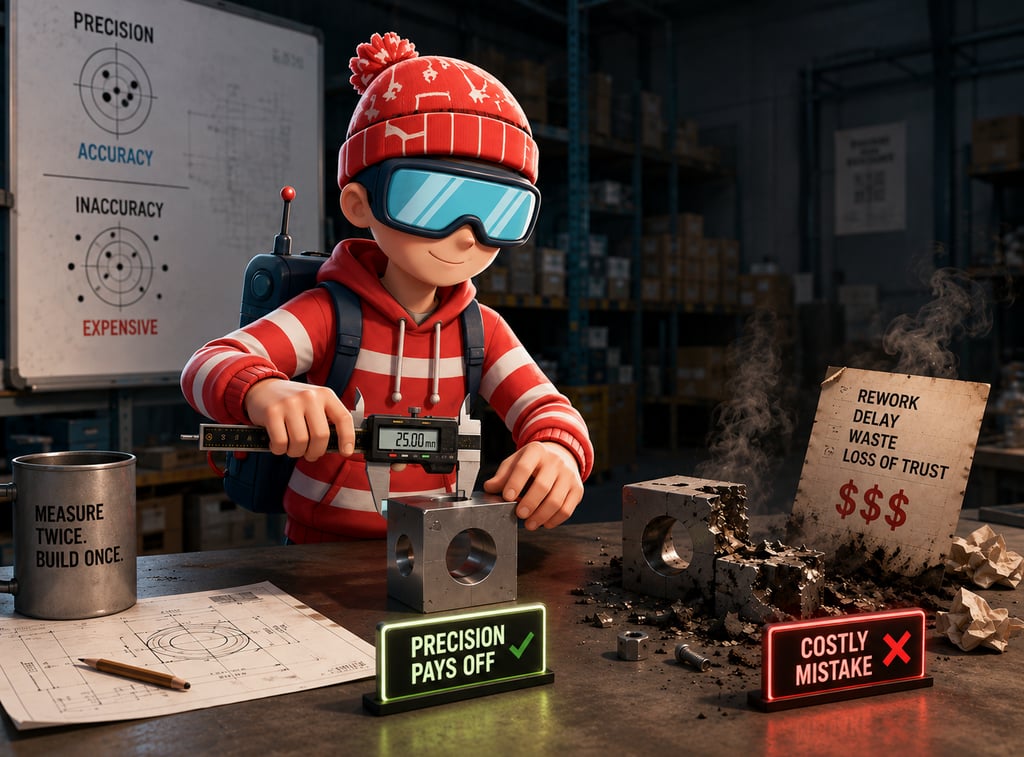
Most people think manufacturing failures are loud.
A machine breaks. A production line stops. Someone starts making urgent phone calls.
The problem is obvious.
The response is immediate.
Everyone knows something went wrong.
The reality is usually stranger than that.
Some of the most expensive manufacturing mistakes are almost invisible when they happen.
A measurement drifts slightly.
A component ends up just outside specification.
A tolerance gets missed by an amount most people couldn't see with the naked eye.
Nothing crashes.
Nobody panics.
Production continues.
At least for a while.
Then parts stop fitting together properly. Inspection teams begin asking questions. Assemblies take longer than expected. Deliveries slip. Customers notice inconsistencies. Suddenly an issue that started with a tiny deviation is affecting people who were nowhere near the original mistake.
That's the thing about modern manufacturing.
The biggest costs often don't come from dramatic failures.
They come from small inaccuracies that quietly move through systems until they become impossible to ignore.
And honestly, this isn't just a manufacturing story.
It's a systems story.
The same pattern shows up in software development, logistics, healthcare, finance, and even personal habits. Small issues rarely stay small when they exist inside interconnected systems.
Manufacturing simply makes the lesson easier to see.
Because when precision matters, tiny problems have a way of becoming very expensive teachers.
The Lie About Small Mistakes
Here's a belief that sounds reasonable but causes a surprising amount of trouble:
A small mistake creates a small problem.
That would be convenient.
It's also rarely true.
Modern manufacturing is built around interconnected processes. One operation feeds another. One component becomes part of a larger assembly. One supplier supports another supplier who supports another supplier.
Everything is connected.
Which means mistakes don't exist in isolation.
Imagine receiving a shipment of components that are all slightly outside specification.
Not enough to immediately fail.
Not enough to stop production.
Just enough to make assembly more difficult.
Workers spend a little more time adjusting.
Quality checks take a little longer.
Production targets become a little harder to hit.
Nobody points to a single catastrophic event because there isn't one.
There is only friction.
And friction has a way of accumulating.
This is why experienced manufacturing leaders tend to worry less about spectacular failures and more about recurring inconsistencies.
Spectacular failures get attention.
Recurring inconsistencies quietly drain resources every day.
One creates a crisis.
The other creates a tax.
A hidden tax paid through delays, extra labor, rework, wasted materials, missed opportunities, and unnecessary stress.
The irony is that organizations often spend enormous effort preparing for major disruptions while overlooking the smaller issues capable of creating long-term damage.
The lesson isn't that every small mistake is catastrophic.
The lesson is that systems amplify whatever enters them.
Good processes create compounding benefits.
Poor accuracy creates compounding costs.
Why Manufacturing Runs on Trust
People often describe manufacturing as a technical discipline.
And it is.
But underneath the machinery, software, and engineering, manufacturing depends on something surprisingly human.
Trust.
Every stage of production assumes the previous stage did its job correctly.
Design teams trust the specifications.
Machinists trust the drawings.
Assembly teams trust the components they receive.
Inspectors trust the measurement systems.
Customers trust the finished product.
The entire operation functions because people believe the process is producing what it claims to be producing.
Most of the time, that trust feels invisible.
Nobody wakes up thinking about it.
Which is exactly how trust works when it's healthy.
You only notice it when it begins to disappear.
Once confidence starts slipping, everything changes.
Teams perform additional checks.
Approvals take longer.
Questions multiply.
People become hesitant.
And hesitation is expensive.
This is one of the least discussed costs in manufacturing.
Not material waste.
Not equipment downtime.
Not even rework.
Hesitation.
The moment people stop trusting outcomes, efficiency begins slowing down.
Maybe only slightly at first.
But systems rarely become slower because of one big event.
They become slower because uncertainty starts spreading through them.
Workers double-check measurements.
Managers request additional verification.
Customers ask more questions.
Suppliers provide extra documentation.
Every precaution makes sense individually.
Collectively, they create drag.
Trust allows systems to move quickly.
Doubt forces them to move carefully.
Sometimes that caution is necessary.
But nobody wants to operate permanently in a state of uncertainty.
That's why consistency matters so much.
Consistency isn't only about quality.
It's about confidence.
And confidence is one of the most valuable assets any manufacturing operation can possess.
The Cost Nobody Sees on the First Invoice
When people calculate manufacturing costs, they usually focus on the obvious numbers.
Raw materials.
Labor.
Equipment.
Transportation.
Utilities.
Those costs are real.
They're also easy to measure.
The harder costs often arrive later.
Let's say a component fails inspection.
On paper, the solution seems straightforward.
Replace the part.
Continue production.
Move on.
Problem solved.
Except it rarely works that way.
The original material has already been consumed.
Machine time has already been used.
Operators have already invested labor hours.
Production schedules have already been built around expected completion dates.
None of those costs disappear when a replacement part is produced.
They remain.
Then new costs arrive.
Additional machine time.
Additional labor.
Additional inspections.
Additional scheduling adjustments.
The replacement part doesn't replace the original investment.
It sits on top of it.
This is where conversations about manufacturing accuracy often become misleading.
People focus on the cost of the defective part.
They ignore the cost of everything connected to it.
The component might be worth a few dollars.
The disruption might be worth thousands.
Or more.
And that's before considering opportunity cost.
While teams are solving preventable problems, they aren't working on improvements.
They aren't increasing capacity.
They aren't pursuing innovation.
They're simply trying to recover lost ground.
That's the part many organizations underestimate.
Bad quality doesn't just create expenses.
It steals attention.
And attention is one of the most limited resources any business has.
The Domino Effect Nobody Budgets For
The most expensive manufacturing problems rarely travel alone.
They bring friends.
A delayed component affects assembly.
Delayed assembly affects testing.
Delayed testing affects shipping.
Delayed shipping affects installation.
Delayed installation affects revenue.
One issue becomes five.
Then ten.
Then twenty.
At some point, people stop talking about the original problem because they're too busy dealing with the consequences.
This is what makes manufacturing systems so fascinating.
And occasionally frustrating.
The outcome is often disconnected from the cause.
By the time a customer experiences a problem, the original mistake may have happened weeks or even months earlier.
The visible consequence appears at the end of the chain.
The root cause sits quietly near the beginning.
That's one reason high-performing manufacturers spend so much time focused on prevention.
Prevention doesn't generate exciting stories.
Nobody celebrates the problem that never happened.
Nobody posts updates about the shipment that arrived exactly when expected.
Nobody writes headlines about systems functioning normally.
But that's where most operational excellence lives.
Inside outcomes that feel ordinary because nothing went wrong.
The biggest manufacturing myth might be that quality costs money.
Poor quality costs far more.
Quality is an investment.
Poor quality is a recurring expense.
One helps organizations move forward.
The other forces them to repeatedly solve the same problems.
And the longer those problems remain hidden inside the system, the more expensive they become.
The difficult part is that inaccuracies rarely announce themselves.
They don't arrive with warning labels.
They don't send calendar invitations.
They simply enter the process and wait.
Sometimes for days.
Sometimes for weeks.
Then eventually, somewhere downstream, someone discovers the bill.
And by then, it's usually much larger than anyone expected.
This Is Where Precision Technology Matters
At some point, every manufacturing conversation ends up in the same place.
Consistency.
Not speed.
Not volume.
Not even cost.
Consistency.
Because consistency is what allows a business to grow without introducing chaos.
Anyone can make one good part.
That's not the challenge.
The challenge is making the hundredth part match the first.
Then making the thousandth part match both of them.
And then doing it again tomorrow.
And next month.
And next year.
This is where manufacturing technology has quietly transformed modern production.
The goal isn't simply automation.
The goal is repeatability.
The best manufacturing systems reduce variation before variation has a chance to become a problem.
That is one reason many organizations rely on processes such as precision CNC machining when tight tolerances, repeatability, and consistency are essential. The technology helps remove many of the variables that can introduce inaccuracies during production, creating outcomes that are more predictable from one production run to the next.
The interesting part isn't the machinery itself.
It's what the machinery allows people to trust.
Reliable measurements.
Reliable dimensions.
Reliable outcomes.
Technology often gets celebrated because it's fast.
The more important achievement is that it makes reliability scalable.
Without consistency, growth becomes difficult.
Every new customer introduces risk.
Every new production run introduces uncertainty.
Every increase in volume creates opportunities for mistakes.
Consistency changes that equation.
It creates confidence.
And confidence is what allows businesses to operate at larger scales without everything becoming fragile.
Precision Is Really About Predictability
People often talk about precision as though it's a quest for perfection.
That's not quite right.
Perfection is a fantasy.
Predictability is practical.
The distinction matters.
Because businesses rarely need perfection.
What they need is reliability.
A manufacturer doesn't need every outcome to be flawless.
A manufacturer needs outcomes to be consistent enough that planning becomes possible.
Customers care about predictability.
Suppliers care about predictability.
Operations teams care about predictability.
Investors care about predictability.
Even employees care about predictability.
When outcomes become consistent, decisions become easier.
Forecasting becomes easier.
Scheduling becomes easier.
Growth becomes easier.
The opposite is also true.
Unpredictable systems force people to spend time managing uncertainty rather than creating value.
That's why precision isn't really about measurements.
It's about reducing surprises.
And surprise is one of the most expensive things any operation can experience.
A surprising defect.
A surprising delay.
A surprising quality issue.
A surprising customer complaint.
Organizations spend enormous resources trying to eliminate surprises.
Precision is simply one of the tools that helps accomplish that goal.
The companies that understand this tend to view quality differently.
They don't see precision as a cost.
They see it as protection.
Protection against disruption.
Protection against inefficiency.
Protection against uncertainty.
That's a much more useful way to think about it.
The Human Side of Precision
Whenever conversations turn toward advanced manufacturing, there is a temptation to focus entirely on technology.
The machines.
The software.
The automation.
The equipment.
Those things matter.
A lot.
But technology rarely deserves all the credit.
Behind every reliable manufacturing system are people making thousands of decisions.
People create processes.
People establish standards.
People identify problems.
People improve workflows.
People decide whether a small issue deserves attention today or gets pushed into tomorrow.
And that last decision is often where larger problems begin.
Because precision isn't just a technical capability.
It's a cultural habit.
Organizations that consistently produce high-quality outcomes tend to share certain characteristics.
They pay attention to details.
They communicate clearly.
They treat small issues seriously.
They encourage people to speak up when something feels off.
Most importantly, they understand that quality is everyone's responsibility.
Not just the responsibility of inspectors.
Not just the responsibility of managers.
Everyone.
That mindset creates something valuable.
Ownership.
When people feel responsible for outcomes, they become more invested in preventing problems before they occur.
And prevention will almost always be less expensive than correction.
Technology can support that effort.
Technology cannot replace it.
The strongest manufacturing systems combine both.
Reliable tools and disciplined people.
That's where the magic happens.
What High-Performing Operations Understand
If you spend enough time studying successful manufacturing organizations, a pattern begins to emerge.
The best operations are rarely obsessed with being perfect.
They're obsessed with being predictable.
That sounds similar.
It's not.
Perfection focuses on outcomes.
Predictability focuses on systems.
One asks:
"Did we achieve the result?"
The other asks:
"Can we achieve the result consistently?"
The second question is usually more important.
Because sustainable success comes from repeatable processes, not isolated victories.
High-performing organizations understand that mistakes are inevitable.
Machines wear down.
People overlook things.
Suppliers encounter challenges.
Unexpected situations appear.
The goal isn't eliminating every possible problem.
The goal is creating systems capable of identifying and correcting issues before they become expensive.
That's a very different mindset.
Instead of asking how to avoid mistakes forever, these organizations ask:
How quickly can we detect them?
How effectively can we respond?
How can we prevent similar issues from happening again?
Those questions create resilience.
And resilience often matters more than perfection.
The strongest systems aren't the ones that never experience problems.
They're the ones that recover efficiently when problems occur.
That's true in manufacturing.
It's true in technology.
It's true almost everywhere.
The organizations that thrive over the long term are usually the ones that build reliability into the system itself.
Not the ones hoping everything goes right.
The Bigger Lesson
What makes manufacturing interesting isn't just the products.
It's the lessons hiding inside the process.
Because manufacturing exposes something that applies far beyond factories and production floors.
Small inaccuracies create large consequences.
Not immediately.
Gradually.
The effect compounds over time.
A tiny measurement issue becomes a quality problem.
A quality problem becomes a scheduling problem.
A scheduling problem becomes a customer problem.
The pattern appears everywhere.
Software bugs.
Financial reporting.
Supply chains.
Healthcare systems.
Personal habits.
Small deviations rarely stay small when they exist inside connected systems.
That's why attention to detail matters.
Not because details are inherently important.
Because details influence outcomes.
And outcomes influence everything connected to them.
This is one reason modern organizations invest so heavily in consistency.
Consistency creates trust.
Trust creates efficiency.
Efficiency creates opportunity.
The chain reaction works both ways.
Positive systems compound just as effectively as negative ones.
That's the encouraging part.
Every improvement matters.
Every refinement matters.
Every small increase in accuracy matters.
Because systems remember what people repeat.
And over time, those repeated behaviors become outcomes.
So What Actually Matters?
Here's the thing.
Most manufacturing failures don't start with dramatic breakdowns.
They start with tiny inaccuracies that seem too small to matter.
Until they do.
The companies that consistently perform well understand this.
They know precision isn't really about chasing perfection.
It's about creating confidence.
Confidence that parts will fit.
Confidence that schedules will hold.
Confidence that customers will receive what they expect.
Confidence that growth won't introduce chaos.
That's why precision continues to matter even as technology evolves.
Not because perfection is becoming easier.
Because predictability is becoming more valuable.
In a world filled with uncertainty, reliable outcomes are surprisingly powerful.
And honestly, that might be the most important lesson manufacturing has to offer.
Technology's greatest achievement isn't making things faster.
It's making them dependable.
The organizations that understand that tend to spend less time reacting and more time building.
That's a pretty good trade.
Subscribe to my newsletter