
Is the Metaverse Dead — or Just Getting Started?
The metaverse went from headline-dominating buzzword to cultural punchline almost overnight. In this TechNaldo deep dive, we unpack what actually happened — why the hype collapsed, which parts quietly survived, and what the future of virtual and augmented worlds realistically looks like. A calm, honest take on why big tech ideas don’t usually die — they evolve.
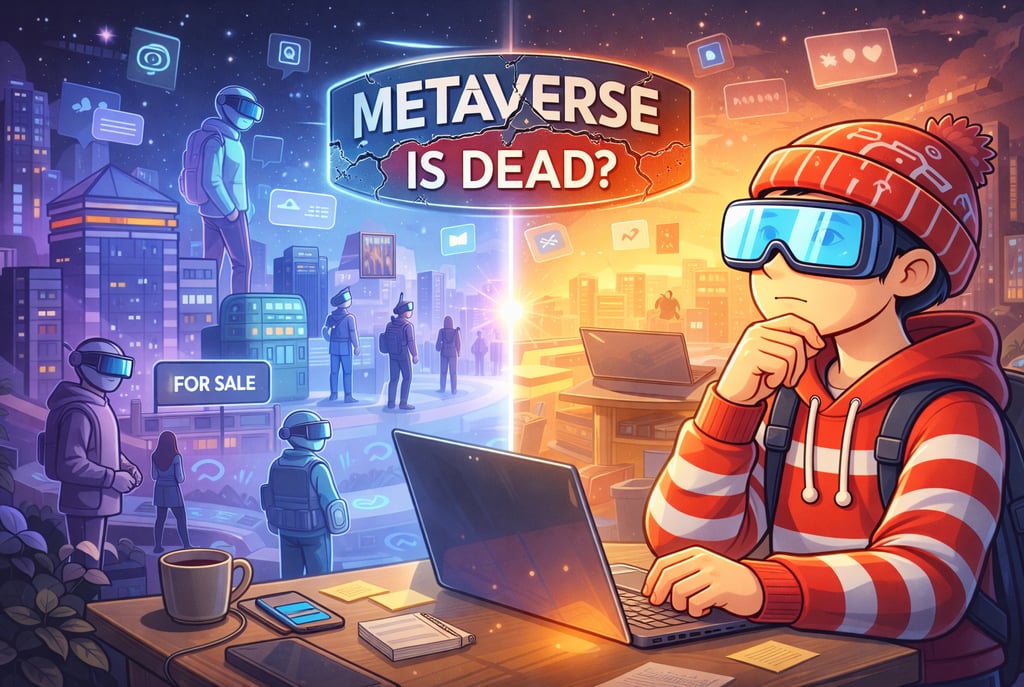
A few years ago, you couldn’t escape the metaverse.
It showed up in keynotes, press releases, and investor decks. Companies renamed themselves after it. Headlines promised digital worlds where we’d work, play, shop, and socialize as avatars.
Then it stopped.
Not with a bang. With a shrug.
The word “metaverse” didn’t get canceled. It just became awkward. Like a trend everyone pretended they never fully believed in.
So what happened?
Did the metaverse fail?
Or did our expectations collapse faster than the technology ever could?
That question matters — not because the metaverse itself is exciting, but because the pattern behind it keeps repeating in tech.
The Strange Life Cycle of Big Tech Ideas
Big tech ideas tend to follow the same arc.
First, a compelling concept appears. Something vague but powerful enough to project hopes onto.
Then hype fills in the gaps. Marketing, speculation, and imagined futures pile on faster than reality can support.
Eventually, the idea gets blamed for failing to live up to expectations it never asked for.
That doesn’t mean the idea was wrong. It means it was premature — or misframed.
The metaverse fits this pattern perfectly.
What People Thought the Metaverse Would Be
When most people heard “metaverse,” they imagined something very specific.
A single, persistent digital world.
Custom avatars.
Virtual offices.
Digital real estate.
Entire lives moved online, just in 3D.
It sounded like the internet — but immersive.
The problem wasn’t imagination. It was assumption.
People assumed:
the hardware would be ready
the social norms would transfer cleanly
people actually wanted to live that way
None of those were guaranteed.
The Avatar Problem No One Wanted to Admit
Avatars were central to the metaverse pitch.
But avatars are complicated.
They require:
effort to customize
comfort with representation
emotional buy-in
For games, that works. People want to role-play.
For work, socializing, or daily life? Much less so.
Most people don’t want to perform constantly. They want tools that reduce friction, not add layers of identity management.
This disconnect alone made the “always-avatar” vision fragile.
What the Metaverse Was Actually Trying to Solve
Strip away the branding and hype, and the metaverse was trying to answer a real question:
How do we feel present with people who aren’t physically near us?
That’s a valid problem.
Remote work exposed how flat video calls can feel. Social platforms exposed how disconnected text and feeds are from real presence.
The metaverse tried to offer a sense of shared space.
The idea wasn’t wrong. The execution just jumped too far ahead.
Why Presence Is Harder Than It Sounds
Presence isn’t about visuals.
You can add realism, 3D depth, spatial audio — and still feel disconnected.
Presence is psychological. It depends on:
comfort
ease
social cues
emotional safety
VR environments often break those subtly. Headsets isolate. Avatars hide expressions. Movement feels unnatural.
When the technology reminds you it’s technology, presence collapses.
That’s the metaverse’s core struggle.
Why the Hype Collapsed So Fast
The metaverse didn’t fail quietly. It collapsed loudly — just not all at once.
A few things converged.
Hardware Wasn’t Ready
VR headsets are better than they were. They’re still not effortless.
They’re bulky. They isolate users. They’re tiring over long sessions.
That’s fine for games. It’s a problem for daily work or casual socializing.
Use Cases Were Forced
Instead of emerging organically, many metaverse experiences were assigned.
Meetings that didn’t need to be immersive became immersive anyway. Social spaces were created without clear reasons to exist.
When tech has to convince people why it’s useful, something’s off.
Corporate Overreach Killed Trust
When large companies tried to “own” the metaverse, skepticism spiked.
The idea of a shared digital future controlled by a few platforms made people uneasy — even if they couldn’t articulate why.
The metaverse started to feel less like a frontier and more like a mall.
The Branding Mistake That Sealed It
Calling it “the metaverse” was a mistake.
Not because the word was bad — but because it suggested singularity.
One place. One future. One version of reality.
That’s not how the internet works. And it’s not how humans behave.
The moment companies tried to brand the future, the future pushed back.
What Quietly Survived the Collapse
Here’s the part most headlines missed.
When the metaverse hype faded, a lot of its underlying tech didn’t disappear. It just stopped being labeled as “the metaverse.”
And that’s a good thing.
VR for Training and Simulation
In healthcare, aviation, manufacturing, and education, VR is quietly useful.
Not flashy. Not social. Just effective.
People learn by doing. VR supports that when real-world practice is expensive or dangerous.
AR in Everyday Life
AR works best when it’s subtle.
Navigation overlays. Measurement tools. Visual guidance.
Not virtual worlds. Just helpful layers.
This is where the future actually lives.
Games Doing It Better Than Corporations
Games have been building metaverse-like spaces for years.
Shared worlds. Avatars. Economies. Social norms.
The difference? Players choose to be there.
Voluntary participation beats forced adoption every time.
Why Games Understand Something Tech Companies Missed
Games succeed because they respect motivation.
People enter game worlds to play, explore, or connect — not because someone told them it’s the future of work.
The metaverse vision ignored that difference.
Work tools need efficiency.
Social tools need comfort.
Games can demand immersion.
Blurring those boundaries caused friction.
The Metaverse Didn’t Die — It Shrunk
Big ideas rarely disappear. They compress.
What we’re seeing now is the metaverse shedding its grand narrative and re-emerging as smaller, focused tools.
Less “digital universe.”
More “useful spatial tech.”
That’s progress.
What the Future Version Probably Looks Like
If the metaverse returns — and parts of it will — it won’t look like the original pitch.
It will be:
fragmented
optional
context-specific
AR used when helpful.
VR used when necessary.
2D tools still doing most of the work.
No single platform. No universal avatar. No mandatory immersion.
The future will be quieter than promised. And more functional.
Why This Pattern Keeps Repeating in Tech
The metaverse isn’t unique.
We’ve seen this with:
social media
crypto
AI narratives
productivity tools
Hype races ahead of behavior. Reality catches up slowly.
The lesson isn’t “don’t innovate.”
It’s “don’t confuse potential with readiness.”
What the Metaverse Teaches Us About Future Tech
A few takeaways matter more than the metaverse itself.
Presence is emotional, not technical
Adoption follows comfort, not capability
Tools succeed when they remove friction
Big ideas need small, boring steps
The future doesn’t arrive fully formed. It sneaks in sideways.
So… Is the Metaverse Dead?
The version people argued about on Twitter?
Probably.
The underlying idea of shared digital presence?
Very much alive.
Just smaller. Quieter. And more realistic.
One Last Thought
Dead ideas don’t leave useful artifacts.
The metaverse left behind better hardware, clearer lessons, and a healthier skepticism about big tech promises.
That’s not failure. That’s refinement.
The future rarely looks like the demo.
It looks like whatever still works after the hype leaves.
Subscribe to my newsletter