
Future Jobs That Don’t Exist Yet (But Will Soon)
What will work look like in the next decade? In this TechNaldo deep dive, we explore how future jobs actually emerge — not from predictions, but from changing workflows, new tools, and growing friction. A grounded look at realistic future roles, the skills behind them, and how to prepare without panic or guesswork.
Predicting future jobs is awkward.
Not because change isn’t real — but because predictions age badly.
A few decades ago, people thought we’d all be commuting in flying cars by now. Instead, we’re still fighting calendar invites and unstable Wi-Fi.
The future rarely arrives as a clean break. It sneaks in through small changes in how work actually gets done.
New jobs don’t usually appear with announcements. They show up as extra responsibilities. Side tasks. Gaps no one officially owns — yet.
That’s where the interesting work starts.
Why Job Predictions Usually Miss the Point
When people talk about “future jobs,” they often imagine brand-new roles appearing overnight.
That’s almost never how it works.
Jobs evolve before they’re named. Titles come later.
At first, someone is just “the person who handles that thing.”
Then it becomes part of a role.
Then a specialization.
Then a job posting.
By the time a job title exists, the work has already been happening for a while.
That’s why the best way to think about future jobs isn’t guessing titles. It’s watching how workflows change.
How New Jobs Actually Form
Most new roles follow a predictable pattern.
First, a new tool or capability appears.
Then people start using it informally.
Then problems emerge around coordination, quality, or responsibility.
Then someone steps in to manage that mess.
That person becomes the role.
Not because they planned it — but because the work needed ownership.
This pattern matters because it tells us where future jobs come from: friction.
Wherever technology creates confusion, overlap, or risk, a human role tends to appear.
Signals That a New Job Is Forming
Instead of guessing wildly, it helps to look for signals.
Here are a few reliable ones.
“Someone Should Own This”
When a task keeps bouncing between people, that’s a sign.
If everyone touches it but no one is accountable, a role is forming.
Manual Oversight Around Automation
Whenever automation enters a workflow, someone has to:
check outputs
correct errors
decide when to trust the system
That oversight often becomes a job.
Translation Between Systems or Teams
When tools don’t talk to each other — or people don’t speak the same technical language — translators emerge.
These aren’t just linguistic translators. They’re context translators.
High Stakes + New Tech
When mistakes are costly, humans stick around longer.
That’s where new roles appear to manage risk, not just efficiency.
Future Jobs That Are Quietly Taking Shape
None of these titles are official everywhere yet.
But the work already exists.
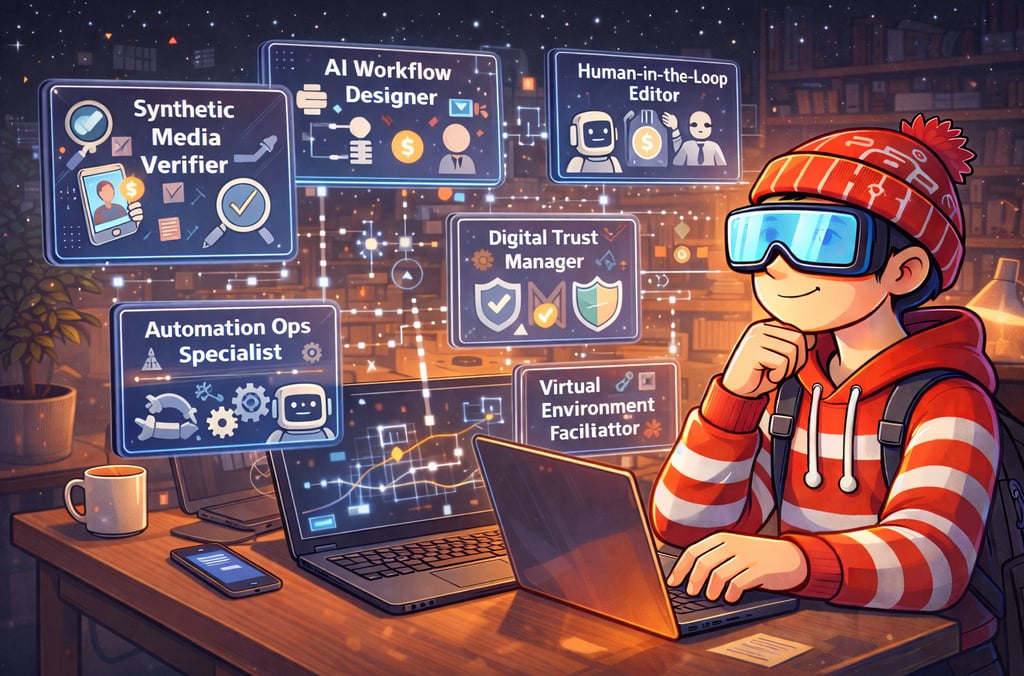
1. AI Workflow Designer
This isn’t about building AI models.
It’s about deciding where AI fits — and where it doesn’t.
AI workflow designers:
map tasks
decide what can be automated
define human checkpoints
prevent tools from being misused
They think in systems, not prompts.
Why it’s emerging:
AI tools are everywhere, but most teams don’t know how to integrate them responsibly.
This role grows out of that confusion.
2. Human-in-the-Loop Editor
Automation works best with supervision.
Human-in-the-loop editors review, adjust, and approve outputs from AI systems before they go live.
This shows up in:
content
customer support
data analysis
compliance
It’s not glamorous. It’s critical.
Why it matters:
Quality and accountability don’t automate easily.
3. Digital Trust Manager
As systems get more complex, trust becomes a job.
Digital trust managers focus on:
transparency
user confidence
ethical use of tech
clear communication around automation
They sit at the intersection of tech, policy, and human behavior.
Why it’s forming:
People don’t just ask “does this work?” anymore. They ask “should I trust this?”
4. Automation Operations Specialist
Automation doesn’t run itself forever.
Someone has to:
monitor failures
update workflows
respond to edge cases
keep systems aligned with real-world changes
This role looks more like maintenance than innovation.
And that’s why it lasts.
5. Virtual Environment Facilitator
Not every virtual space needs to be immersive — but some need structure.
Facilitators manage:
virtual meetings
online learning environments
hybrid collaboration spaces
They focus on flow, engagement, and clarity.
Why it’s emerging:
Remote work isn’t going away. But unmanaged virtual spaces are exhausting.
6. Data Context Analyst
Data doesn’t explain itself.
Context analysts focus on:
interpreting outputs
explaining limitations
connecting numbers to decisions
They don’t generate data. They make it usable.
Why it matters:
More data without context leads to worse decisions, not better ones.
7. Personal AI Trainer
As people use AI tools daily, customization becomes valuable.
Personal AI trainers help individuals:
tailor tools to their needs
understand strengths and limits
avoid misuse
This is less about coding and more about guidance.
Why it’s forming:
AI literacy is uneven. People want help — not manuals.
8. Synthetic Media Verifier
As generated content spreads, verification becomes essential.
Verifiers focus on:
identifying manipulated media
confirming authenticity
explaining uncertainty
This isn’t about catching everything. It’s about reducing harm.
Why it’s necessary:
Trust erodes faster than tech improves.
Why These Jobs Don’t Feel Obvious Yet
Because most of them don’t look like “jobs.”
They look like:
added responsibilities
side projects
internal roles
informal ownership
That’s how new work always starts.
The people doing it now won’t always have titles. But they’ll have leverage.
Why Titles Matter Less Than Skills
Focusing on titles locks you into guesses.
Focusing on skills keeps you flexible.
The skills behind most future roles are already valuable:
systems thinking
communication
judgment
coordination
adaptability
These skills don’t expire quickly.
Tools change. Workflows evolve. Human capabilities persist.
How to Prepare Without Guessing Wrong
You don’t need to predict the future perfectly.
You need to stay adjacent to change.
A few practical approaches help.
Learn How Systems Connect
Understand how tools fit together, not just how to use them individually.
Build Comfort With Ambiguity
Future roles often start without clear instructions.
That’s not a flaw. It’s an opportunity.
Develop Judgment, Not Just Speed
Speed gets automated first. Judgment doesn’t.
Stay Curious, Not Anxious
Curiosity leads to exploration. Anxiety leads to paralysis.
Only one is useful.
What Won’t Change as Much as People Think
Some things remain stubbornly human.
Trust
Responsibility
Taste
Communication
No matter how advanced tools become, these stay central.
Future jobs won’t remove humans. They’ll reposition them.
Why This Is Actually Reassuring
The future of work isn’t about being replaced.
It’s about being repositioned closer to decisions, oversight, and meaning.
The work that disappears is usually:
repetitive
context-free
unowned
The work that grows is connective.
That’s good news — if you’re paying attention.
One Last Thought
The future doesn’t hire people who guessed right.
It hires people who learned how to learn.
New jobs don’t arrive fully formed. They appear as messy, undefined work that someone decides to take responsibility for.
If you’re willing to sit in that uncertainty — and make things clearer for others — you’re already closer to the future than you think.
Subscribe to my newsletter